

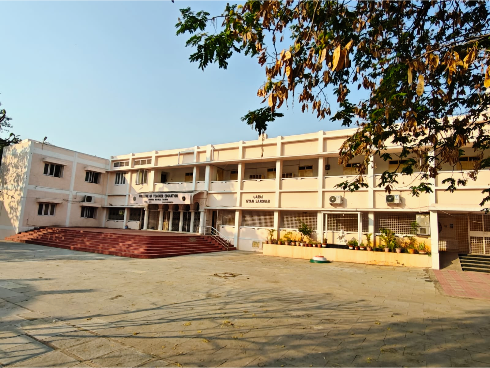
 The origin of the College of Teacher Education at Andhra Mahila Sabha can be traced back to the unwavering dedication and energetic leadership of Padma Vibhushan Dr. Durgabai Deshmukh. Recognised as the Founder President of AMS, the first voluntary organisation in India advocating for women’s empowerment, Dr. Deshmukh established this college in 1971. The journey began with obtaining permissions from the Government of Andhra Pradesh and securing affiliation with Osmania University. Over the years, the college developed, earning recognition as a College of Teacher Education — a rare achievement for a private aided institution — thereby broadening its responsibilities beyond teacher training to include orientation programmes, content enrichment initiatives, workshops, seminars, and research projects.
In 1997, the college was officially upgraded to a College of Teacher Education (CTE), a prestigious privilege granted to a private aided college of education. As a CTE, the college’s responsibilities grew; in addition to conducting pre-service teacher training programmes for primary and secondary levels, it also organises orientation programmes, content enrichment programmes, workshops, seminars, and research projects on key areas of content delivery. Currently, the college offers five teacher education programmes, ranging from Early Childhood to Postgraduate levels, namely B.Ed., M.Ed., B.Ed. Special Education (H.I.), P.G. Diploma in Early Childhood Education (ECE), and Telugu Pandit Training (TPT) Programme.
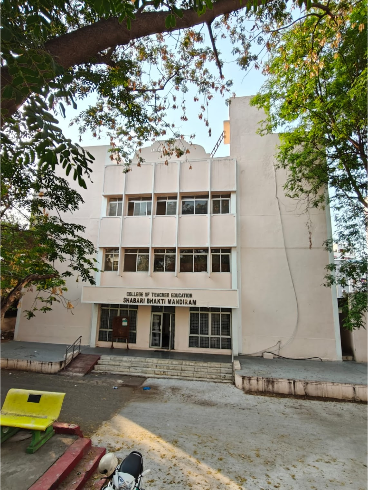 The college is a Study Centre for Sri.Padmavathi Mahila Vishwa Vidyalayam, Tirupathi (A.P), and Dr.B.R. Ambedkhar Open University, for conducting B.Ed. and M.Ed. (Distance Mode) teacher training programmes for government primary and secondary teachers. The college offers consultancy services to primary and secondary teachers of private schools as and when they approach the institution. It also conducts job fairs and provides placement services to pre-service students and alumni. A class above other Colleges of Education in the State, this college can boast, without any misgivings, that it is setting a benchmark in maintaining high-quality education relevant to societal needs, and in its unique achievement of certain milestones that merit a brief mention hereinafter.
The inaugural lamp of B.Ed. was lit by then Vice-Chancellor of O.U., Prof. Ravada Satyanarayana, in 1971. The college was admitted to Grant-in-Aid, Section 2f, and 12 B of UGC, receiving UGC grants from V Plan onwards in 1976. In 1984, a unique Post Graduate Diploma in Early Childhood Education (ECE), the only programme of its kind in the nation, was introduced. UGC recognised it as a restructured programme. The P.G. Programme (M.Ed.) was inaugurated by Prof. G. Ram Reddy in 1992 by the then Vice-Chancellor of O.U. The college celebrated its Silver Jubilee in 1996. An Alumni Association was established and inaugurated by Prof. E.G. Parameswaran. The college was upgraded to a College of Teacher Education (CTE) in 1997. As a CTE, it receives grants from MHRD, Government of India, to enhance infrastructural facilities such as buildings, hostels, equipment, books, and labs. The B.Ed. in Special Education (H.I.) programme was introduced in 2000. The college began Telugu Pandit Teacher Training (TPT) courses in 2002. The Language Lab and the Audiology Lab were also inaugurated that same year. The college was granted autonomy in 2007. B.Ed. (Regular) and B.Ed. in Special Education courses now operate under autonomous status. It had been an autonomous institution for a long time. It was accredited by NAAC with a B++ grade in 2007 and reaccredited in July 2024.
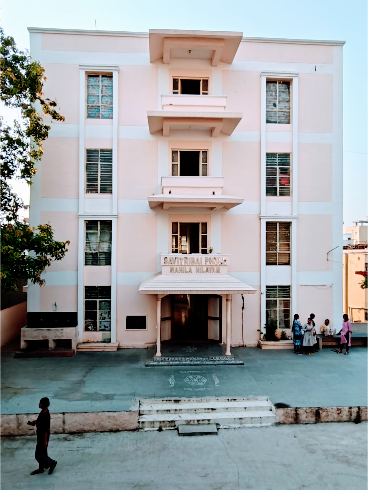 Furthermore, it was the pioneering institution in the voluntary sector to secure a project from UNICEF via NCERT, culminating in the establishment of the State Resource Centre (SRC) in Early Childhood Education (ECE) in Andhra Pradesh. Padma Vibhushan Dr. Durgabai Deshmukh’s visionary aspirations led to the founding of numerous institutions, including the College of Teacher Education and Andhra Mahila Sabha. Her dream, as she expressed, was to create a comprehensive educational continuum where a girl beginning her educational journey at Mahila Sabha in the nursery stage could complete it with a B.Ed. course. Exploring the milestones achieved by the institution, its progress is marked by significant accomplishments. From securing grants and introducing unique programmes like the P.G. Diploma in Early Childhood Education recognised by the UGC, to being designated as a state resource centre for early childhood education by UNICEF, the college has consistently set benchmarks in education. The journey continued with the introduction of various programmes, the attainment of autonomous status, accreditation from NAAC, and the conduct of numerous seminars, workshops, and conferences catering to society’s educational needs.
The College of Teacher Education, Andhra Mahila Sabha, has established a distinctive identity in the field of teacher education. Its dedication to meeting society’s evolving needs has solidified its reputation, setting a remarkable standard in the educational landscape. AMS CTE actively works to raise educational standards through various strategies. Founded on the visionary ideals of its Founder, the institution focuses on a core value system embedded in its ethos. Program differentiation remains a key feature, promoting diverse academic pursuits. Engaging students in both curricular and co-curricular activities enhances their learning experience. The college supports digital transformation, optimising resource use for better learning outcomes.
It adopts modern teaching methods and offers scenario-based learning options, while closely tracking student performance to support informed decision-making. The institution continually updates course structures to meet changing student needs and ensures effective communication channels for smooth information flow. AMS CTE nurtures teachers by fostering commitment, integrity, creativity, and innovation, instilling essential values, attitudes, and interests in future educators.
 Furthermore, the college addresses critical educational challenges by aiming to reduce disparities in access to education. It regularly enhances curricula with innovative teaching approaches and provides guidance and counselling through mentoring programmes. The institution also offers certificate courses and online education specifically for ECCE students.
Using Task-Based Learning through projects, integrating ICT into language and computer laboratories, and encouraging the Student Quality Circle help optimise resource use. Annual job melas, creative collaborative learning methods, training in cultural competence, establishing a redressal and grievance cell, and promoting personal responsibility and initiatives are among the various measures employed to tackle these challenges.
The college provides an array of courses spanning from Early Childhood Education to post-graduation, aligning closely with NEP 2020 guidelines. Through a memorandum of understanding with PMSL-DPS, it offers a three-month certificate course in ECCE. Additionally, the institution has revamped its curriculum to address 21st-century skill requirements. To bolster students’ professional capabilities, a digitalised library equipped with Koha Software and INFLIBNET services is available for every course. Moreover, students engage in a school observation project, gaining insights into the intricacies of the teaching-learning process. Classroom seminars, assignments, project presentations, and internal evaluations are integral components that enhance students’ mastery of subject matter. The institution focuses on honing abilities and offers value-added courses to foster self-confidence and develop interpersonal skills. Furthermore, students gain practical experience through internships in standard schools, supervised regularly by Methods Masters.
Embracing Gandhi Bhavan programs, the college instills Gandhian ethos and spiritual values in its students. National and International day celebrations contribute to the development of presentation and communicative skills. The provision of guest and extension lectures across various subjects enriches students’ knowledge base. Embracing innovative teaching methods like flipped classrooms, blended learning, project-based problem-solving, design thinking, cooperative learning, and the jigsaw approach reflects a dynamic shift toward a constructivist educational approach.
The Andhra Mahila Sabha College of Teacher Education maximizes the opportunities encountered to enhance the quality of education provided. Supported by a conducive social environment, community involvement, student enthusiasm, and faculty commitment, our focus remains on serving the community, especially women. It aims to introduce more job-centric courses catering to community needs while upholding unparalleled quality.
Emphasis is placed on enhancing students’ capabilities through diverse learning methods, including group and individual presentations, reflective documentation, workshops, and tutorials. The curriculum is crafted with a keen eye on innovation and local requirements.
The Founder’s vision was for the institution to grow into an institute of excellence in teacher education. The management leaves no stone unturned to materialize her vision. However, students should not treat courses in teacher education as a stopgap, and the government should support the institution in every way.